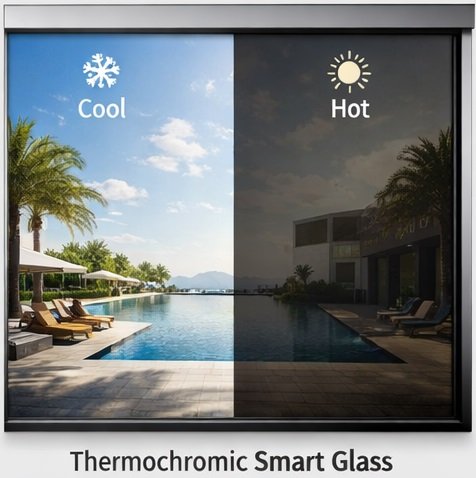
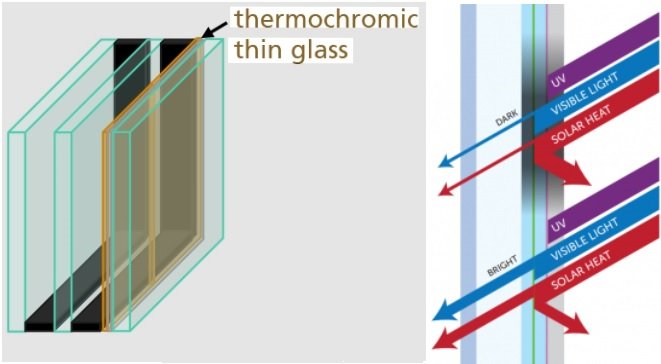
Thermochromic smart glass in sustainable buildings is a passive window technology that automatically tints or clears in response to temperature changes, reducing HVAC energy use by blocking solar heat in summer (tinted) and allowing it in during winter (clear), enhancing comfort and energy savings without electricity, by using materials like vanadium dioxide that shift optical properties with heat.
How it works
- Passive Response: Unlike electrically-controlled smart glass, thermochromic glass uses the sun’s heat to change its tint automatically.
- Material Science: It incorporates special coatings or layers containing thermochromic materials, such as vanadium dioxide (VO2), that undergo reversible phase transitions.
- Summer (Heat): As outdoor temperatures rise, the material transitions to a more opaque, reflective state, blocking infrared (heat) and visible light, keeping buildings cooler.
- Winter (Cool): When temperatures drop, the glass becomes more transparent, allowing sunlight and warmth in to naturally heat the building.
Benefits for Sustainable Buildings
- Energy Efficiency: Reduces reliance on air conditioning in summer and heating in winter, lowering energy consumption and costs.
- Comfort: Manages glare and discomfort from direct sunlight, improving indoor comfort and productivity.
- Passive Design: Acts as a passive design strategy, integrating seamlessly into standard window frames (IGUs) without complex wiring.
- Cost-Effective: Generally less expensive to install than more complex smart glass technologies like electrochromic, notes this ScienceDirect article.
Key Materials & Innovations
- Vanadium Dioxide (VO2): A common material that shifts from an insulating (transparent) to a metallic (reflective) state around 68°C (154°F).
- Nanotechnology: Advanced coatings use nanoparticles to fine-tune infrared reflection and visible light transmission for better performance.
- Integration: Can be applied as a coating or as an interlayer in laminated safety glass for easy integration into existing building designs