
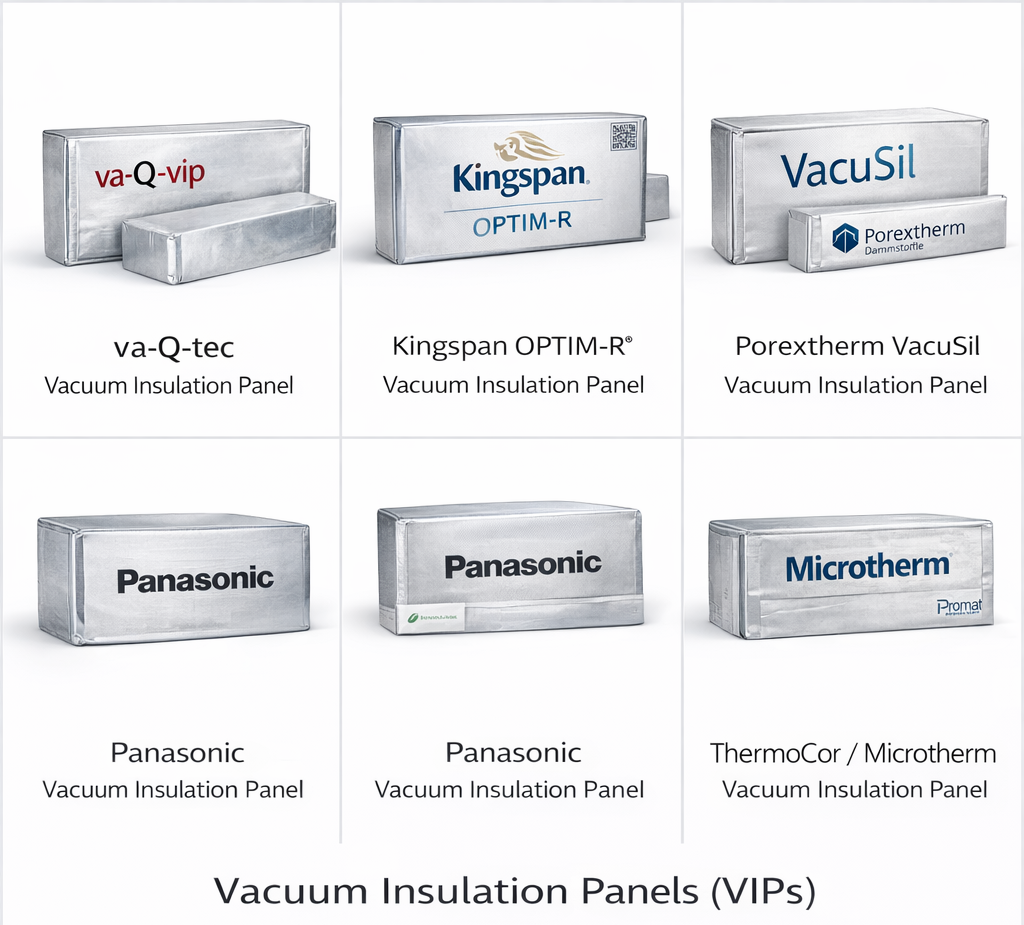
Overview: Vacuum Insulation Panels (VIPs) are advanced construction materials used for thermal insulation in sustainable buildings, offering a significantly higher R-value (a measure of thermal resistance) per unit of thickness compared to traditional insulation materials. They are primarily used for their excellent thermal performance, not typically for sound insulation .
Composition and Mechanism
A VIP consists of three main components:
- Core Material: A porous material with an open-pore structure, such as fumed silica, precipitated silica, or fiberglass, that provides mechanical strength and maintains the panel’s shape.
- Getter: A material that absorbs any residual gases or moisture within the panel to maintain the vacuum over its service life.
- Envelope/Casing: A multilayer, high-barrier film laminate that encloses the core and is hermetically sealed to maintain the internal vacuum .
The principle behind VIPs is that heat transfer (conduction and convection) is dramatically reduced in a vacuum environment. By removing the air from the porous core, the only significant modes of heat transfer remaining are solid conduction through the core material and thermal radiation across the vacuum gap.
Key Characteristics in Sustainable Buildings:
- Exceptional Thermal Efficiency: VIPs provide a thermal conductivity as low as 0.002–0.004 W/m·K, which is roughly five to ten times better than conventional insulation materials like expanded polystyrene (EPS) or mineral wool .
- Space Saving: Their high performance allows for much thinner wall, floor, or roof assemblies to meet stringent energy codes, maximizing usable floor space within a building .
- Sustainable Use Cases: They are ideal for retrofitting existing buildings with limited space for insulation, or for new “passive house” designs and net-zero energy buildings that require very high thermal performance.
Limitations:
- Vulnerability: The performance of a VIP is critically dependent on maintaining the integrity of its vacuum seal. Punctures or damage to the envelope will cause the panel to lose its vacuum and revert to the thermal performance of its core material at atmospheric pressure.
- Moisture Sensitivity: Any moisture ingress can also compromise performance.
- Acoustic Performance: While highly effective as a thermal barrier, VIPs typically provide poor sound insulation on their own. They are rigid and thin, lacking the mass and damping properties required for effective acoustic insulation. Acoustic performance usually needs to be achieved through other means within the construction assembly.