
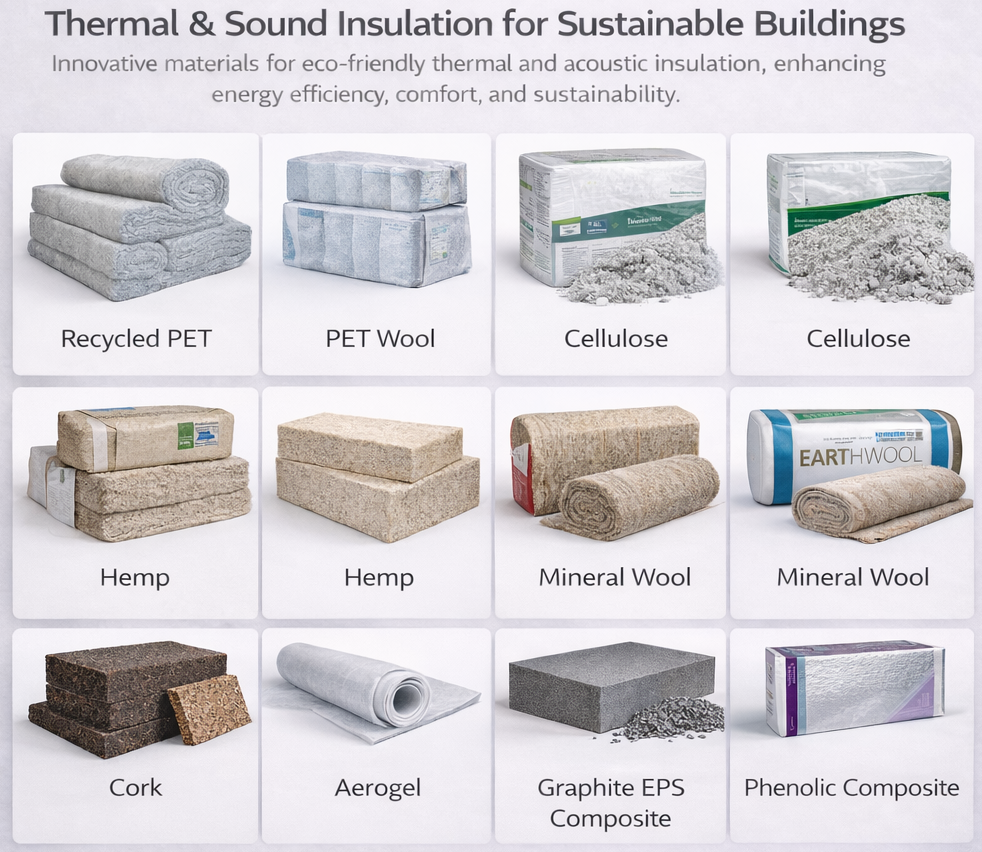
Overview: Thermal and sound insulation in advanced sustainable construction uses innovative materials (like recycled PET, cellulose, or hemp) to reduce heat transfer (conduction, convection, radiation) and control sound transmission, improving building energy efficiency, occupant comfort, and reducing environmental impact, often combining both functions into a single material for high-performance walls, roofs, and floors in green buildings.
Thermal Insulation:
- What it is: Materials that resist heat flow (low thermal conductivity), keeping buildings warm in winter and cool in summer, thus minimizing energy for heating/cooling.
- How it works: Reduces heat transfer via conduction, convection, and radiation.
- Advanced Materials: Recycled PET, bio-based fibers (hemp, cellulose), aerogels, phase change materials (PCMs).
Sound (Acoustic) Insulation:
- What it is: Materials and techniques that control sound transmission (noise) between spaces, reducing reverberation and blocking airborne/impact sound.
- How it works: Absorbs sound energy, converts it to heat, or blocks its path through dense barriers.
- Advanced Materials: Mineral wool, cork, recycled textiles, composites with specific fiber arrangements (jute/polyester).
In Advanced Sustainable Construction:
- Combined Function: Many modern materials offer both thermal (low conductivity) and acoustic (sound absorption/blocking) properties, like fiber-reinforced composites or panels with added graphite.
- Sustainability Focus: Emphasizes recycled content (PET, cellulose), natural fibers (hemp, jute), biodegradable options, and materials that reduce building operational energy use.
- Benefits: Higher energy efficiency, lower energy bills, quieter interiors, improved occupant health, reduced carbon footprint, and better compliance with green building standards (LEED, BREEAM).