
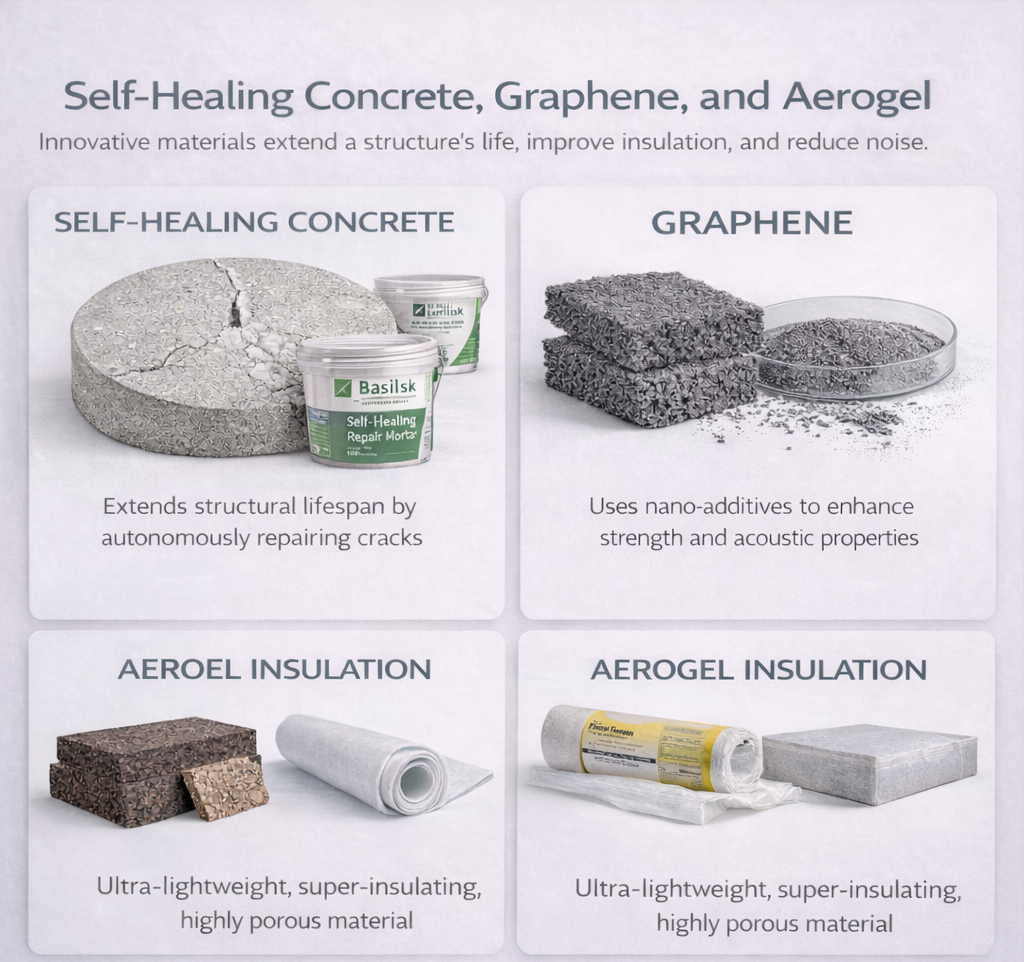
Overview: self-healing concrete, graphene, and aerogel primarily enhance durability, energy efficiency, and occupant comfort by extending a structure’s life, improving insulation, and reducing noise.
Self-Healing Concrete:
- Primary Function: Extends the structural lifespan and reduces maintenance needs by autonomously repairing cracks, thus preventing material degradation and the need for frequent, resource-intensive repairs. This mechanism enhances sustainability by reducing material consumption and the associated carbon footprint.
- Thermal and Sound Insulation Role: Its direct role in thermal or sound insulation is limited. The main contribution to the building’s overall performance is indirect: by sealing cracks, it prevents air and moisture ingress that would otherwise compromise the integrity and performance of the building envelope, thereby helping to maintain the designed insulation effectiveness over time.
Graphene:
- Primary Function: Used as a nano-additive to enhance the mechanical properties (strength, durability, flexibility) and other functionalities of traditional construction materials like concrete and foams.
- Thermal and Sound Insulation Role:
- Sound Insulation: Graphene foam composites are effective acoustic absorbers. The introduction of graphene foam creates a highly porous network within materials (like cement walls or polymer foams), which increases airflow resistance and sound wave tortuosity, leading to significant noise reduction (up to 20% or more compared to traditional materials).
- Thermal Insulation: While graphene is highly conductive in its pure form, when engineered into specific structures (e.g., graphene oxide foams or in low concentrations within EPS modules), its thermal conductivity can be reduced. This creates highly effective, low-density thermal insulation materials that trap heat through multiple internal reflections and complicated heat conduction paths.
Aerogel Insulation:
- Primary Function: Renowned for exceptional insulating properties, aerogels are ultra-lightweight, highly porous materials (up to 99.8% air) often referred to as “frozen smoke”.
- Thermal and Sound Insulation Role:
- Thermal Insulation: Aerogels possess extremely low thermal conductivity, making them superior insulators to traditional materials like fiberglass or foam. Their nanoporous structure effectively impedes heat transfer, significantly reducing energy consumption for heating and cooling, which is a major benefit for sustainable, energy-efficient buildings.
- Sound Insulation: Aerogels also have good soundproofing capabilities, as their intricate porous structure helps to dissipate sound energy and reduce noise transmission through walls and ceilings.
- Sustainability: Their use in building design aligns with sustainability goals by enabling high energy efficiency and reducing the operational carbon footprint of buildings.