
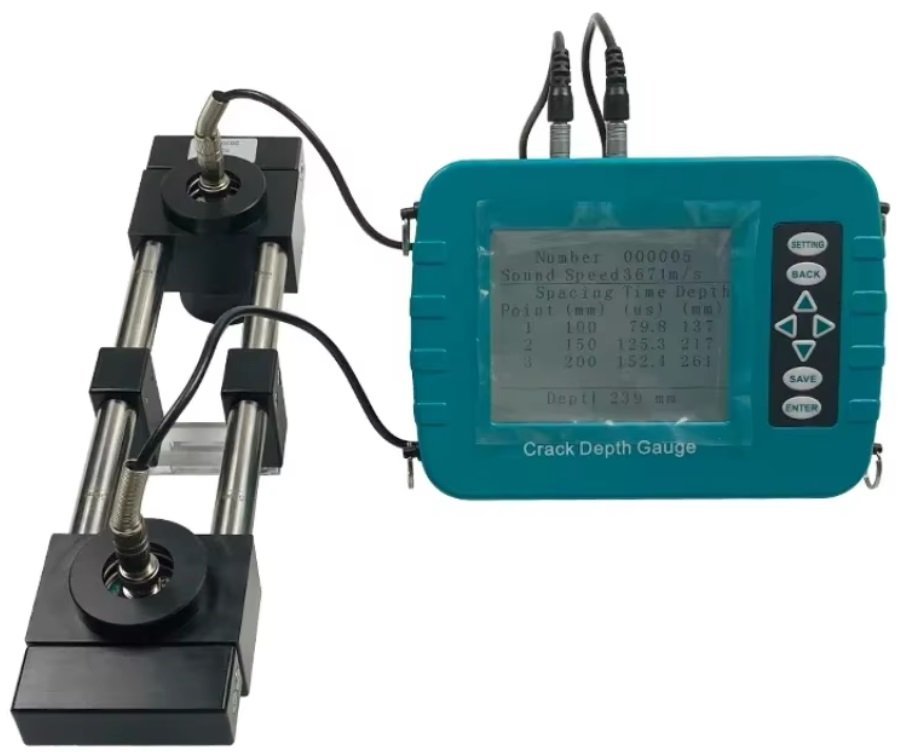
A crack meter in smart buildings is an electronic, IoT-enabled device designed for the continuous, real-time, and long-term monitoring of structural cracks in materials like concrete or masonry. It measures the movement (widening, contraction, or shearing) across a crack, allowing for the immediate detection of potential structural failures without requiring manual, on-site, or in-person inspections.
Key Aspects of Smart Crack Meters:
- Automatic Data Transmission: Modern sensors (e.g., NB-IoT, LoRaWAN) automatically transmit data to a central system or cloud-based platform, enabling remote monitoring.
- High Precision and Sensitivity: Capable of detecting minute changes, often with a resolution of 0.01 mm.
- 3D Monitoring: Advanced models (3D crack meters) track movement along three axes (X, Y, Z), allowing for the measurement of lateral shear, settlement, and opening/closing.
- Versatility: Beyond just width, they are used for monitoring joint movements in dams, bridges, and tunnels, as well as structural bending in ceilings or beams.
- Environmental Monitoring: Advanced crack meters often include sensors for temperature and humidity to account for movement caused by environmental factors rather than structural failure.
- Integration: Data from these devices can be incorporated into Building Information Modeling (BIM) systems for comprehensive structural health management.
Types of Smart/Connected Crack Meters:
- Vibrating Wire: Uses a wire under tension; a change in distance between anchors alters the tension, and the resulting frequency shift is measured.
- Potentiometric/Linear Displacement: Uses linear variable differential transformers (LVDT) to directly measure the displacement.
- Fiber Optic: Uses fiber optic technology to monitor cracks, offering high precision.
- Wireless Node: Sensors connected to a node, which then transmits data over long distances.
These devices are crucial for identifying if a crack is “active” or “live” (i.e., changing) and for ensuring structural safety in both existing and new buildings.