
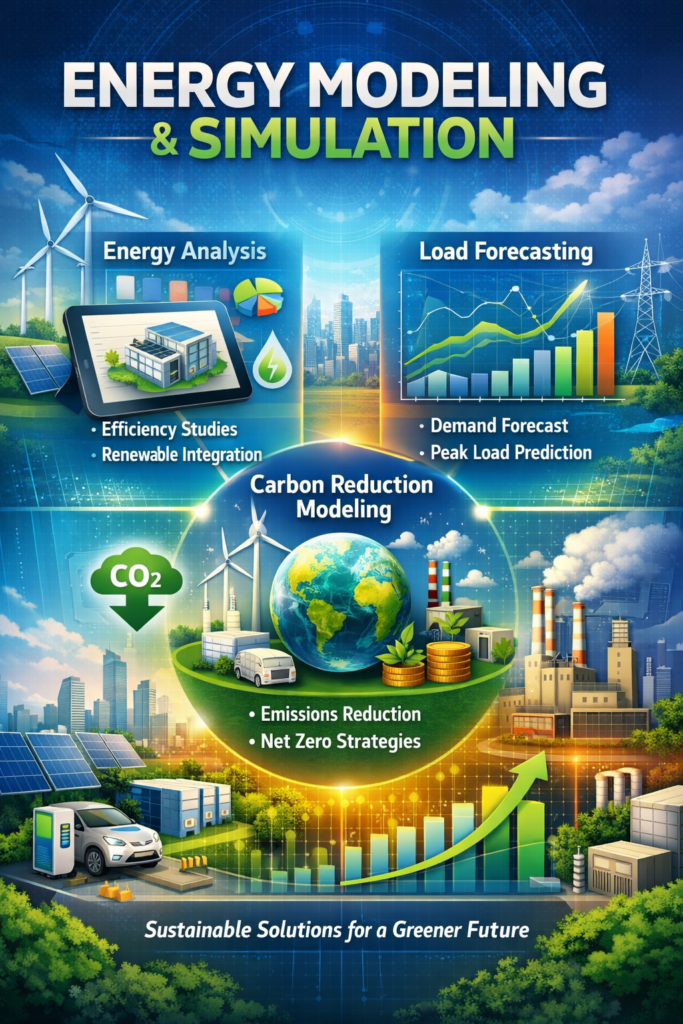
Why Energy Modeling & Simulation is Important
- Optimization of Design:Enables testing of passive solutions (orientation, shading) and active solutions (HVAC, lighting) to minimize energy use.
- Cost Reduction:Predicts energy bills and evaluates the lifecycle payback of energy-saving investments.
- Compliance and Certification:Required for energy code compliance (e.g., ASHRAE 90.1, California Title 24) and green building certifications (LEED, BREEAM).
- Operational Efficiency:Post-construction, models can be calibrated with real-time data from Building Management Systems (BMS) to identify inefficiencies.
Common Methodologies & Tools
- Software:EnergyPlus, eQUEST, IES VE, DesignBuilder.
- Approaches:
- White-box (Physical) Models:Based on engineering principles (e.g., EnergyPlus).
- Black-box (Data-driven) Models:Using Machine Learning (ML) and Artificial Neural Networks (ANN) on historical data for load forecasting.
- Hybrid Models:Combining physical and machine learning methods.
- Integration:7D BIM (Building Information Modeling) integrates 3D geometry with energy, cost, and sustainability data.
By using these tools, stakeholders can move from prescriptive design to performance-based design, ensuring that modern buildings are sustainable, energy-efficient, and cost-effective.
Core Components of Energy Modeling & Simulation
- Involves using software (e.g., EnergyPlus, IES VE, DesignBuilder) to simulate the building’s energy behavior hourly over a full year, accounting for local weather data, occupancy schedules, and thermal properties. It allows for comparing design options, such as testing the energy impact of different window-to-wall ratios or insulation levels.
Carbon Reduction Modeling:This involves calculating the greenhouse gas emissions associated with a building's entire lifecycle, including both "embodied carbon" (from materials and construction) and "operational carbon" (from daily energy use). It allows for testing strategies to achieve net-zero targets by optimizing renewable energy integration, such as solar photovoltaic (PV) systems.

This is a subset of simulation used to calculate maximum heating and cooling demands. It determines the necessary capacities of HVAC equipment and airflow requirements to ensure indoor comfort while avoiding oversized, inefficient systems.